Best Solar System Planetarium Kit for Kids
Explore the wonders of space with engaging, classroom-grade planetarium kits designed for curious minds. This guide highlights five top solar system kits that teach astronomy through hands-on assembly, interactive projection, glow effects, and movable parts. Each option supports science learning at home or in the classroom, helping kids understand planetary orbits, scale, and space phenomena with age-appropriate materials.
| Product | What It Teaches |
|---|---|
| 4M Solar System Planetarium | Hands-on assembly, glow-in-the-dark planets, wall chart |
| Science Can Solar System (Talking Projector) | Interactive, bilingual facts, wall projection of planets |
| National Geographic Glow Solar System | Glow-in-the-dark display, movable arms, all-in-one kit |
| Science Can Interactive Solar System | Talking model with discs and quiz mode |
| Nine Planets DIY Solar System | Wood model, two-part build, fact cards |
Each product below provides a unique approach to learning: from glow-in-the-dark displays and projectors to wooden models and interactive talking features. All are suitable for ages roughly 5 to 12, supporting STEM exploration, creative thinking, and classroom-ready demonstrations.
4M Solar System Planetarium Kit

The 4M Solar System Planetarium kit guides kids through assembling a planetary model that glows in the dark. It includes planets, stencils, glow paint pens, rods, string, a wall chart, and a set of quiz questions. The assembly process supports fine motor skills and following instructions, while the final glow model provides a striking display for bedrooms or classrooms. The included fact-filled wall chart complements the hands-on activity with science background and planet names for quick reference.
Science Can Solar System Projector (Talking)
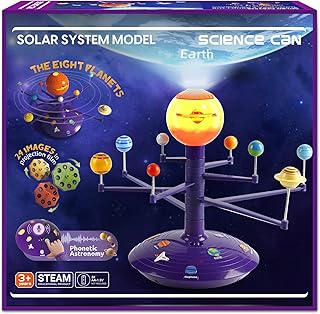
This talking solar system model doubles as a projector. It enables projection of the eight planets onto any surface and includes both English and Spanish options. Kids can press planet patterns on the base to access educational facts, enriching space knowledge with an interactive, bilingual experience. The projector uses disks to display 24 full-color images, including planets, spaceships, and astronauts, turning any room into a mini planetarium. Suitable for independent learning or group demonstrations, it supports early STEM exploration.
National Geographic Glow-In-The-Dark Solar System Model Kit

This National Geographic kit offers a vivid 3D solar system with glow-in-the-dark elements. It includes six vibrant paints, glow accents, a brush, a palette, decals, and an informational poster. The kit is designed for easy assembly and display, with movable arms to adjust planet positions. The glow feature makes it ideal for nighttime viewing and classroom demonstrations, providing a tangible, visual representation of solar orbits and sizes while reinforcing key facts from the included poster.
Science Can Solar System Interactive (Projector & Discs)

This interactive solar system model packs 53 quiz questions and three knowledge cards to foster inquiry-based learning. It balances English and French options for bilingual learning. The planetarium projector, with three discs, projects 24 full-color images of planets and space phenomena, enabling immersive demonstrations on walls or ceilings. The combination of tactile play, informational content, and visual projections supports diverse learning styles and classroom activities.
Nine Planets DIY Solar System Kit

This complete DIY kit offers a wood model, a second puzzle piece, and fact cards that help kids learn about the major nine planets. The two-part build supports problem-solving and design thinking, as well as visual-spatial skills. Painting and assembling the model provides a hands-on, tangible way to explore planetary order, sizes, and features. The included fact cards summarize essential information for quick reference during projects or science fairs.
Buying Guide
Key purchase considerations help parents and educators choose the right solar system planetarium kit for their goals:
- Learning goals: Do you want hands-on building, visual projection, or a glow-in-the-dark display? Choose a kit that aligns with your teaching objectives and the student’s interests.
- Age and skill level: Consider whether the kit’s complexity suits early elementary, late elementary, or middle-grade learners. Some kits feature simpler assembly, while others include advanced features like movably arms or bilingual content.
- Engagement features: Look for interactive elements such as talking features, disks with images, or quiz questions. These features sustain curiosity and reinforce astronomy concepts.
- Display and storage: If the display will be a bedroom or classroom centerpiece, glow-in-the-dark or projector-based options can be more impactful. Consider space for assembly and subsequent display.
- Supplementary materials: Wall charts, posters, fact cards, and decals augment learning by providing reference material during and after building.
- Durability and materials: Wood models tend to be sturdy and reusable for science fairs, while plastic kits often offer decals and paints for quick setup.
- Educational scope: Some kits focus on the eight planets with a sun or include a ninth planet concept. Ensure the kit covers the depth of astronomy you want to explore.
Across these options, the chosen kits emphasize hands-on learning, visual demonstrations, and consistent science content. For classroom settings, a projector-based or glow-in-the-dark kit often supports group demonstrations, while DIY wooden or all-in-one kits are excellent for individual projects and science fairs. When paired with guided questions and a short lesson plan, these kits can significantly enhance understanding of planetary order, orbits, and solar system scale.