Best Portable WiFi for Planes: Top Travel Routers for in-Flight Internet
The rise of mobile work and always-connected travel makes in-flight internet a must-have. This guide reviews five highly capable portable WiFi routers that work well on planes, hotels, and other travel scenarios. Each option combines strong VPN features, open-source firmware support, and multi-gigabit ports to keep you online and secure while airborne. Below, you’ll find concise product highlights, a quick comparison table, and a buying guide to help you choose the right model for frequent flyers and remote workers alike.
| Product | Brand | Key Strengths On Planes | OpenVPN/WireGuard |
|---|---|---|---|
| GL.iNet GL-MT3000 (Beryl AX) | GL.iNet | Wi‑Fi 6, 2.5G WAN, VPN ready | Yes |
| TP-Link BE3600 TL-WR3602BE | TP-Link | Private network from public Wi-Fi, 90 devices | Yes |
| GL.iNet GL-BE3600 (Slate 7) | GL.iNet | Wi‑Fi 7, touchscreen, dual 2.5G | Yes |
| IntoGalaxy 2025 Portable WiFi Hotspot | IntoGalaxy | Global satellite-like connectivity, compact | depends on model |
| GL.iNet GL-AXT1800 (Slate AX) | GL.iNet | Wi‑Fi 6, MU‑MIMO, OpenVPN/WireGuard | Yes |
Note: The table highlights core strengths for air travel, but actual in-flight performance depends on airline Wi-Fi quality, seat configuration, and VPN service speed.
GL.iNet GL-MT3000 (Beryl AX) Review

The GL-MT3000 supports dual-band AX with 2.4 GHz and 5 GHz bands, offering speeds up to 574 Mbps and 2402 Mbps respectively. It features a 2.5G WAN port and a 1G LAN port, plus a USB 3.0 port for network storage or printer sharing. With pre-installed VPN options including OpenVPN and WireGuard, it can encrypt all connected devices. OpenWrt 21.02 firmware enables extensive customization via thousands of plug-ins, ideal for travelers who want flexible VPN routing and advanced networking on planes or in airports.
In flight scenarios, the MT3000’s VPN performance is practical for securing public Wi‑Fi usage. Real-world VPN speeds vary, yet the device remains capable of maintaining secure, multi-device connections within a compact travel footprint. The device’s OpenWrt ecosystem and admin panel offer a no‑code interface for managing packages, making it suitable for tech‑savvy travelers who need reliable in-flight privacy.
TP-Link BE3600 Wi‑Fi 7 Portable Travel Router TL-WR3602BE

The BE3600 is designed to convert public Wi‑Fi into a private network anywhere you travel. It supports up to 90 devices simultaneously and provides VPN connectivity for secure remote work. The router delivers up to 2882 Mbps on the 5 GHz band and up to 688 Mbps on 2.4 GHz, delivering robust performance for streaming, downloads, and remote work on planes and in hotels. It operates in multiple modes, including Router, Hotspot, and AP/Client, offering flexible options to extend or secure in-flight connections. Note that 6 GHz support is not included in this model.
For in-flight use, the private network feature helps keep your devices isolated from shared aboard networks, reducing potential exposure on public Wi‑Fi. The high device support and VPN compatibility make it a strong choice for travelers who require reliable, secure connectivity across many gadgets while on long flights or layovers.
GL.iNet GL-BE3600 (Slate 7) Portable Travel Router

The Slate 7 combines Wi‑Fi 7 capability with a touchscreen interface for quick setup and monitoring. It supports dual-band Wi‑Fi 7 with speeds up to 688 Mbps on 2.4 GHz and 2882 Mbps on 5 GHz, plus dual 2.5G ports (WAN and LAN) and a USB 3.0 port. OpenWrt 23.05 firmware provides deep customization and a broad plugin ecosystem, allowing advanced users to tailor VPN, firewall, and sharing features. The built-in touchscreen offers real-time status updates and simple VPN toggling, which is useful for travelers who frequently change networks on planes, hotels, and airports.
On planes, the Slate 7’s flexibility and performance can help create a stable, private network even when public Wi‑Fi is crowded. The device’s open firmware and broad VPN support help maintain secure access to corporate resources or personal services while in transit.
IntoGalaxy 2025 Portable WiFi Hotspot

The 2025 portable hotspot emphasizes global connectivity with compact design suited for travel. It promises high-speed satellite-like connectivity up to 500 Mbps, aiming to provide reliable in-flight internet access and outdoor use anywhere you go. The pocket-sized form factor makes it easy to carry in a pocket or small bag, ensuring you can stay online during flights, layovers, and remote work sessions when other networks are less dependable. It is designed for universal device compatibility, making it straightforward to connect laptops, smartphones, tablets, or streaming devices during travel.
When assessing in-flight practicality, consider coverage areas and data plans. While the device offers impressive portability and speed, actual in-flight performance will also depend on airline Wi‑Fi quality and any satellite-like service constraints. This model provides a compelling option for travelers who prioritize compactness and wide compatibility in planes and airports.
GL.iNet GL-AXT1800 (Slate AX) Portable Travel Router
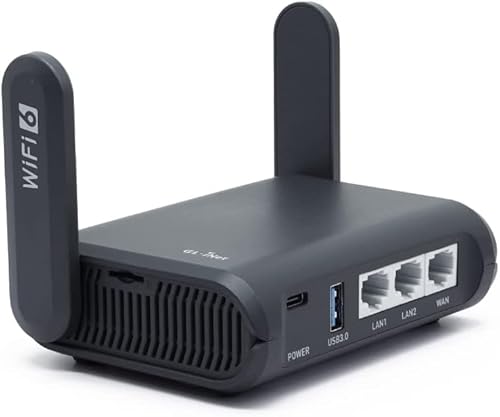
The Slate AX delivers AX router performance with a combined 1800 Mbps across bands (600 Mbps 2.4 GHz, 1200 Mbps 5 GHz). MU‑MIMO and OFDMA improve multi-device efficiency, making it suitable for planes with many devices connected simultaneously. It supports IPv6 and pre-installed OpenVPN and WireGuard, enabling fast VPN speeds—OpenVPN up to 500 Mbps and WireGuard up to 550 Mbps. Built-in NAS sharing via SAMBA and WebDav is a practical feature for travelers who need to store and access files across devices while on the go. The device emphasizes strong security and performance in a compact form factor, ideal for frequent flyers who require robust networking on planes and in transit.
In flight, the Slate AX’s combination of high-speed Wi‑Fi 6/AX capabilities, VPN options, and NAS features makes it a versatile choice for remote workers and digital nomads who want secure, fast internet on airplanes, hotels, and transit hubs.
Buying Guide: Key Purchase Considerations
- Network standards and speed: Wi‑Fi 6/6E/7 compatibility provides better performance in crowded airports and on planes. If you routinely connect many devices, look for MU‑MIMO, OFDMA, and multi‑gigabit ports (2.5G or 10G) to maximize throughput.
- VPN support: Ensure the device includes OpenVPN or WireGuard pre-installed or simple setup. A reliable VPN helps protect on‑board privacy when using public networks and corporate resources securely.
- Firmware and customization: OpenWrt or similar open-source firmware gives extensive customization options, plugin support, and fine-grained control over routing, firewall, and VPN rules—useful for advanced users who travel often.
- Portability and power: For flights, a compact device with a robust battery (if applicable) or easy USB power compatibility matters. Consider devices with USB 3.0 for storage sharing or printer sharing if needed during travel.
- Network extension modes: Routers with multiple modes (Router/Hotspot/AP/Client) provide flexibility to connect to hotel Wi‑Fi, public networks, or tether devices via Ethernet or USB, which is helpful in planes with varying network setups.
- Device capacity: If you travel with many devices (laptops, tablets, phones, streaming players), verify the router’s ability to handle dozens of connections without congestion, especially in shared seats or lounges.
- Security features: Look for IPv6 support, built-in encryption, and secure DNS options. Some devices offer built-in NAS features for local file sharing, which can be a plus for on-this-trip data access without cloud dependencies.
In summary, the best portable WiFi solutions for planes balance high-speed wireless performance with strong VPN capabilities, flexible network modes, and open firmware for customization. Whether you prioritize the latest Wi‑Fi standard, rugged device versatility, or compact design, the options listed here cover a range of travel styles and security needs.