Best Telescopes for Planets and Galaxies: Clear Skies for Astronomy Enthusiasts
Discover approachable, feature-rich telescopes ideal for observing planets, galaxies, and other celestial wonders. This guide highlights five well-rounded options from trusted brands, each offering helpful accessories, easy setup, and smartphone compatibility for modern stargazing. Whether you’re a beginner or upgrading your backyard setup, these picks cover a range of apertures, mounts, and capabilities to help you spot craters, spiral arms, and distant nebulae with clarity.
Summary of Selected Products
| Product | Brand | Aperture | Mount Type | Key Benefit |
|---|---|---|---|---|
| Celestron StarSense Explorer LT 114AZ | Celestron Store | 114mm | Altazimuth with StarSense | Smartphone-guided sky navigation |
| MEEZAA 90mm Refractor | MEEZAA Store | 90mm | AZ Mount | Bright, wide views; versatile for beginners |
| Smart Telescope with 4K Camera | FASHIONARI Store | 80mm | Altazimuth with dual screens | 4K imaging; portable and user-friendly |
| Dianfan 150EQ | Dianfan Store | 150mm | Equatorial mount | High light-gathering power for deep-sky viewing |
| Dianfan 90mm Refractor | Dianfan Store | 90mm | Altazimuth with tripod | Balanced mix of portability and performance |
Celestron StarSense Explorer LT 114AZ

The Celestron StarSense Explorer LT 114AZ is a beginner-friendly 114mm Newtonian reflector that emphasizes simplicity through smartphone-assisted sky navigation. Dock your smartphone, launch the StarSense Explorer app, and follow on-screen arrows to locate planets, nebulae, galaxies, and star clusters. This approach reduces the guesswork of star-hopping and makes celestial targets more accessible in urban skies.
Key advantages include patented StarSense technology, which analyzes star patterns overhead to pinpoint the telescope’s position, providing a guided observing experience. The app also curates tonight’s best targets based on your time and location, enabling rapid access to visible planets, bright nebulae, and clusters from light-polluted areas or dark skies alike.
Typical use cases: introducing families to astronomy, casual stargazing after sunset, and educational demonstrations for students learning the night sky. The 114mm aperture balances light-gathering capacity with portability, while the altazimuth mount supports intuitive aiming. For those seeking a modern, app-enabled path to celestial discovery, the StarSense LT 114AZ offers a compelling mix of automation and hands-on viewing.
MEEZAA 90mm Refractor Telescope

The MEEZAA 90mm aperture refractor offers a practical entry point into amateur astronomy with an 800mm focal length (f/8.88). Its fully multi-coated optical glass lenses improve light transmission and color accuracy for brighter, crisper views of the Moon, planets, and brighter deep-sky objects. With two eyepieces and a 3x Barlow lens, users can achieve magnifications ranging from 32x to 240x, letting observers explore lunar detail or distant star clusters.
The package typically includes an AZ mount and a carrying bag, making it suitable for family outings or classroom demonstrations. For newcomers or casual hobbyists, the 90mm aperture delivers a noticeable step-up in light-gathering compared with smaller refractors, while remaining manageable in size and price.
Smart Telescope With 4K Imaging

This professional-grade smart telescope pairs an 80mm aperture with a 300mm focal length for sharp, bright planetary and lunar views. It supports up to 350x magnification for distant targets and can capture 4K high-resolution images, even in challenging lighting. A dual-screen display (internal and foldable external) provides real-time viewing, while a built-in sunshade improves daytime usability. The one-touch switch feature enables quick photo and video capture, and the device supports large external storage up to 512GB for storing celestial moments.
Designed for both beginners and more serious observers, this telescope emphasizes portability and ease of use without sacrificing imaging flexibility. Its autofocus capabilities and intuitive controls help users document transient events like meteor showers or planetary transits with minimal setup.
Dianfan 150EQ Professional Telescope
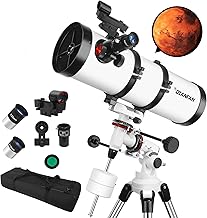
The Dianfan 150EQ is a high-aperture 150mm reflector designed for serious beginner-to-intermediate users. Its 650mm focal length supports a balance of wide-field views and moderate magnification. The kit includes a pre-assembled equatorial mount, a 2× Barlow lens, and a variety of eyepieces, enabling magnifications from 26x to 130x. The German-style EQ mount with slow-motion controls offers smoother tracking for lunar features, planets, and brighter deep-sky targets, while the included carrying bag and tripod enhance portability for field observing and family stargazing sessions.
With this aperture, observers can pursue more demanding deep-sky objects, such as brighter galaxies and star clusters, while maintaining a straightforward setup process. It is a practical step up from entry-level refractors for those ready to explore the full night sky with more control over tracking and focus.
Dianfan 90mm Refractor Telescope

The 90mm Dianfan refractor offers a compact, versatile option for beginners and families exploring celestial targets. With a focal length of 800mm (f/8.9), the telescope emphasizes bright, high-contrast views, aided by fully coated optics. The kit includes a sturdy stainless tripod and a phone adapter for capturing observations. A 3× Barlow lens expands magnification with available eyepieces, while a zenith-facing orientation ensures upright terrestrial viewing. This option is well-suited for those seeking a portable setup that remains capable for both sky-and-ground observing.
Buying Guide: Key Purchase Considerations
- Aperture and light collection: Larger apertures gather more light and reveal fainter deep-sky objects, but add weight and cost. For planets and galaxies, consider 90–150mm class refractors or reflectors for a balanced experience.
- Mount type and tracking: Altazimuth mounts are intuitive for beginners and quick observations, while equatorial mounts provide smoother tracking for longer exposures and astrophotography.
- Ease of use and automation: App-guided sky navigation or built-in target lists can reduce setup time and increase observing sessions, especially in light-polluted areas.
- Optics quality and coatings: Fully multi-coated lenses improve brightness and contrast. Taxonomy of optics (refractor vs reflector) impacts color fidelity and image sharpness for planetary vs deep-sky viewing.
- Portability and storage: Consider weight, balance, and included carrying bags. A compact scope is ideal for travel or park-side stargazing.
- Imaging and accessories: If you want to capture astrophotography, check for camera adapters, compatibility with smartphones, and support for external storage or cameras.
- Durability and warranty: Look for solid build quality, stable tripods, and reliable customer support to ensure long-term satisfaction.
- Urban vs dark-sky viewing: In bright cities, prioritize higher-quality optics and targeted accessories to maximize contrast and visibility of planets and galaxies.
Overall, these selections balance beginner accessibility with the potential for deeper exploration. For families and new hobbyists, app-guided models provide quick wins and intuitive operation. For aspiring observers who want more precise control or imaging options, mid-range refractors and equatorially mounted reflectors offer scalable pathways to advanced observing sessions without overwhelming complexity.