Best Telescopes for Stars and Planets: Top Picks for Beginners to Enthusiasts
| Product | Brand | Main Benefit | Aim |
|---|---|---|---|
| Gskyer Telescope, 70mm | Gskyer | Portable travel-friendly optics | Kids, beginners, casual stargazing |
| Telescope, 90mm (HETEKAN) | HETEKAN | Higher light-gathering and versatile magnification | Adults, beginners, quick setups |
| Dianfan Telescope, 90mm | Dianfan | Bright, sharp planetary and lunar views | Beginners, families |
| MEEZAA Telescope, 90mm | MEEZAA | Professional-grade optics for clearer images | Adults, astronomy learners |
| HEXEUM Telescope, 80mm | HEXEUM | Compact portability with multi-coated optics | Travel, kids and adults |
Choosing the right telescope for stars and planets involves balancing aperture, magnification range, portability, and ease of use. The products below span entry-level travel options to more capable setups suitable for beginners and curious observers. Each model emphasizes clear optics, straightforward assembly, and practical accessories to help you observe the Moon, planets, and brighter deep-sky targets with confidence.
Gskyer 70mm Refractor Telescope

The Gskyer 70mm aperture telescope offers a compact entry point for stargazers. With a 400mm focal length (f/5.7) and fully coated optics, this refractor delivers bright, crisp views of the Moon’s craters and bright planets. The kit includes two eyepieces and a 3x Barlow lens, which can triple the magnification for closer lunar detail or planetary observations. A 5×24 finder scope with crosshair lines helps locate targets, while a wireless remote and smartphone adapter enable easy photo capture of celestial scenes. This setup emphasizes portability and simplicity, ideal for travel or casual backyard sessions.
Key features include a lightweight AZ mount for easy tracking, entry-level optics designed to reduce eye strain, and beginner-friendly assembly. The combination of multiple eyepieces and a Barlow lens provides a practical range from wide-field scouting to higher magnification on illuminated targets. The included carry bag helps keep components organized for on-the-go use. For families or young aspiring astronomers, this model pairs approachable usability with surprisingly solid optical performance for its class.
HETEKAN 90mm Refractor for Adults

The HETEKAN telescope targets adult beginners and curious observers who want more light-gathering power. Its 90mm aperture enhances brightness and reveals finer lunar details and planetary features. The fully multi-coated optical glass lenses minimize reflections while improving contrast. With a focal length of 900mm, it supports magnifications from 36X to 450X using three eyepieces (25 mm, 10 mm, 6 mm) plus a 3x Barlow lens. Included accessories such as a 5×24 finder, a phone adapter, and a sturdy stargazing mount contribute to straightforward setup and steadier viewing. This model suits those seeking clearer images without stepping into complex astronomy gear.
Observers benefit from the versatile magnification range, enabling wide-field views of larger star clusters and closer views of the Moon’s terminator. The design prioritizes user-friendly operation, with simple alignment and stable tracking. While higher magnifications reveal more detail, they require stable mounts and dark skies for optimal results. This telescope provides a balanced platform for learning and exploring, whether you’re observing planetary phases or lunar maria.
Dianfan 90mm Aperture Portable Refractor

Dianfan’s 90mm aperture telescope emphasizes bright, vivid imaging with a focal length of 800 mm. The design uses a fully coated objective and high-transmission coatings to deliver sharp, high-contrast views of the Moon, planets, and brighter deep-sky objects. It ships with two eyepieces and a 3× Barlow lens to offer observers 32× to 240× magnification. A 45° zenith mirror ensures upright images for terrestrial use, helpful for both sky and ground viewing. Quick setup and a user-friendly build make it well-suited for families and new enthusiasts who want fast results after an assembly session.
Included accessories—such as a stainless tripod and a phone adapter—support multimedia exploration, enabling you to capture celestial moments. The telescope’s combination of moderate aperture and practical features makes it a solid step up from ultra-basic models while keeping the process approachable for beginners. For those curious about lunar topography or planetary disc details, this telescope provides reliable optics with straightforward operation.
MEEZAA 90mm Refractor for Astronomy

The MEEZAA telescope targets adults and beginners seeking a professional-grade optical experience. It features a 90mm aperture and 800mm focal length with fully multi-coated optics to maximize brightness and contrast. The scope uses two eyepieces (10 mm and 25 mm) and a 3x Barlow lens to reach a magnification range of 32X to 240X. A sturdy AZ mount, tripod, and phone adapter support flexible viewing angles and photography. The accompanying carry bag adds portability, making it convenient for stargazing trips or field observations. This setup emphasizes image clarity and ease of use for learners and enthusiasts alike.
While the optics deliver crisp planetary and lunar views, the system remains approachable for beginners when paired with the included accessories. Guidance through the StarSense-like approach of aligning and locating objects isn’t provided here, but the combination of magnification versatility and stable mounting makes it a reliable option for expanding early astronomy skills into more ambitious skywatching sessions.
HEXEUM 80mm Portable Refractor
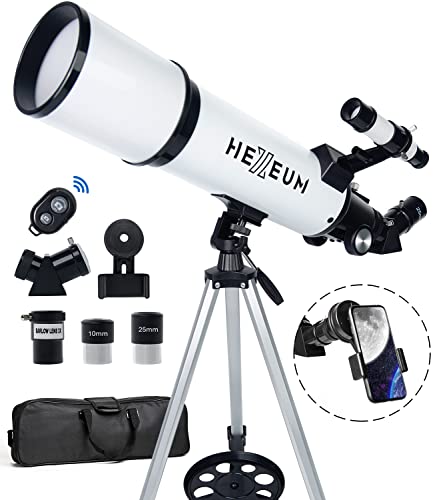
The HEXEUM telescope offers an 80mm aperture with a 600mm focal length, combining portability with capable optics. The optical system uses fully multi-coated high transmission coatings to boost brightness and reduce reflections, helping observers see lunar features and planetary discs more clearly. With two eyepieces (25 mm and 10 mm) and a 3x Barlow lens, magnification ranges from 24X to 180X. A 5×24 finder scope simplifies object location, while the included phone adapter, wireless remote, and carrying bag heighten convenience for on-the-go astronomy. This model aims to balance travel-friendly design with respectable image quality for casual observers and families.
Users should note that higher magnifications demand stable mounting and darker skies. The ergonomic tripod and lightweight frame make setup straightforward, and the wireless control enables easy photo or video capture of bright celestial targets. For beginners seeking a compact, versatile instrument, this telescope provides a practical blend of portability and optical performance.
Buying Guide: Key Purchase Considerations And Comparisons
- Aperture and light gathering: Larger apertures (80–90 mm) collect more light, improving brightness and detail on planets and the Moon. If you mainly observe the Moon and brighter planets, an 80–90 mm scope offers a good balance between performance and portability.
- Focal length and magnification: Shorter focal lengths yield wider fields of view, while longer focal lengths enable higher magnification. Look for models with multiple eyepieces and a Barlow lens to cover a useful range without extra purchases.
- Optical quality: Fully coated or multi-coated optics reduce reflections and improve contrast. This is especially important for high-contrast lunar features and planetary detail.
- Mount type and stability: An AZ (easy-tracking) mount is beginner-friendly, but a steady tripod or a simple equatorial setup helps when using higher magnifications. A stable base minimizes wobble and enhances viewing accuracy.
- Accessories: A finder scope, phone adapter, and a carrying bag add practical value for beginners. A wireless remote is handy for capturing images without touching the telescope.
- Weight and portability: Travel-friendly telescopes suit backyard sessions and quick field trips. For portability, lighter models with compact tripods are advantageous.
- Ease of setup: Look for models marketed toward beginners with clear assembly instructions and intuitive controls. Short setup times (15 minutes or less) help maintain observing momentum between sessions.
- Future-proofing: If you anticipate expanding your sessions, choose a telescope with room to grow—higher magnifications, compatible accessories, and robust mounts can accommodate longer-term interest.
In summary, for beginners and families, the recommended approach is to start with an 70–90 mm refractor or a compact 80–90 mm model featuring multi-coated optics and a user-friendly mount. Prioritize ease of use, stable support, and included accessories like a smartphone adapter for photos. For learners who want to observe more detail on the Moon and planets, a model with a higher focal length and versatile eyepieces, such as those listed here, can provide more satisfying early experiences without overwhelming complexity.