Best Speed Controller for Drone: Top ESCs for FPV Drones
Choosing the right speed controller is essential for FPV drones, balancing reliability, heat management, and performance. This guide highlights five high-quality ESCs designed for 2S–6S LiPo packs, BLHeli_S firmware, and compact builds. Each option is evaluated for current capability, cooling features, and ease of integration with 4-in-1 and individual ESC setups. Use the buying guide below to compare specs and decide which ESC fits your drone’s power system and flight style.
| Product | Brand | Voltage Range | Current (A) | Notes |
|---|---|---|---|---|
| 4Pcs 20A ESC | SoloGood Store | 2-4S | 20 | BLHeli_S, twisted signal line |
| 40A ESC | — | 2-4S | 40 | 5V 3A BEC, XT60 |
| SEQURE 65A 4in1 | SEQURE Store | 2-6S | 65 | 32-bit PWM, high frequency |
| 30A ESC (2 pcs) | Flylin Store | 2-4S | 30 | XT60 and 3.5mm plugs, heat dissipation |
| HNYYZL 45A ESC | HNYYZL Store | 2-6S | 45 | RGB LED, D-Shot support |
Across these selections, builders gain options from compact 20A units to a 4-in-1 65A system, with firmware and hardware designed to minimize interference and maximize flight time. The following sections break down each product’s strengths, practical use cases, and integration tips for both beginner and advanced drone builders.
4Pcs 20A ESC for FPV Drones
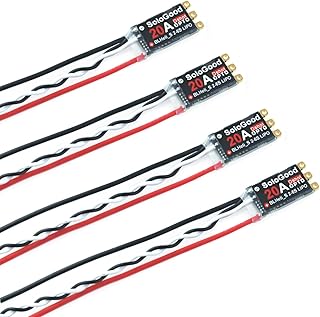
This 4-pack of 20A brushless ESCs targets FPV quadcopters and QAV-style builds. With BLHeli_S firmware, these controllers are designed for easy upgrading or flashing via the ESC signal cable. A twisted throttle signal pair helps reduce crosstalk during signal transmission, which is beneficial in high-speed flight where clean control signals are critical. Suitable for 2- to 4-cell LiPo packs, these ESCs emphasize reliable current handling for small to mid-sized quads, supporting straightforward calibration and responsiveness.
40A ESC With BEC for RC Drones

This 40A electronic speed controller is designed for 2-4S LiPo systems and includes a 5V/3A BEC. The unit supports rapid current delivery with a low-loss profile and is suited for larger quad configurations or light multi-rotor aircraft. Its linear BEC regulation is reliable for powering auxiliary flight electronics such as receivers and small sensors. The stated maximum speeds reflect motor compatibility for common 2-pole, 6-pole, or 12-pole motors, making it a flexible option for expanding builds.
SEQURE 65A 4in1 ESC for FPV Racing

The SEQURE 65A 4in1 ESC uses an AT32F421 32-bit processor and supports PWM frequencies from 8 kHz to 96 kHz, delivering continuous 65A with peak up to 120A. Its high-power MOSFETs offer efficient power conversion, reducing loss and extending flight time. With a compact 30.5mm mounting footprint, it’s well-suited for larger, high-load racing drones or freestyle builds requiring a consolidated ESC solution and streamlined wiring harnesses.
30A ESC Duo With XT60 Plugs

This kit includes two 30A ESCs, each with XT60 and 3.5mm bullet plugs for flexible motor connections. It emphasizes dependable 30A continuous current with 40A peak ratings, plus an engineering focus on reducing electromagnetic interference. Quick heat dissipation is supported by independent heat sinks and optimized MOSFET arrangement, helping to maintain performance under demanding flight maneuvers and high-current conditions common in acrobatic or racing drones.
HNYYZL 45A ESC with Damped Light

The HNYYZL 45A ESC supports 2S–6S LiPo packs and includes RGB LED lighting to visualize status and telemetry, alongside D-Shot compatibility for precise motor control. With a continuous 45A output and 55A peak for short bursts, it targets mid-sized racing or freestyle drones that require robust power in a compact form. The 18 AWG wiring and compact size are designed for space-constrained builds while delivering reliable current delivery during hard cornering and rapid throttle changes.
Buying Guide: Key Considerations For Selecting a Drone ESC
- Current rating and peak bursts: Match the ESC’s continuous current with your motor’s draw at full throttle, plus reserve for bursts during aggressive maneuvers. Higher-pole motors may demand higher peak ratings.
- Voltage range compatibility: Ensure the ESC supports your LiPo configuration (2S–6S is common). Some units offer 2-4S or 2-6S ranges for versatility in different builds.
- Firmware and upgradability: BLHeli_S or similar firmware provides smoother throttle response and easier flashing. Consider whether the signal line design minimizes crosstalk for stable control.
- Cooling and heat management: Heatsinks, robust MOSFETs, and thermal design reduce thermal throttling during long flights or high-power climbs.
- Configuration form factor: Decide between single ESCs or a 4-in-1 ESC board based on wiring complexity, weight, and the drone’s footprint.
- BEC requirements: Some ESCs include a built-in BEC to power the flight controller and receiver. Verify voltage and amperage to avoid conflicts with your power setup.
- Mechanical fit and wiring: Check mounting hole spacing, wire gauge, and connector types (XT60, bullet plugs) to ensure compatibility with your motors and frame.
- Telemetry and diagnostics: Some ESCs offer telemetry, status LEDs, or damped light indicators to aid troubleshooting during flights and test runs.
- Reliability and brand support: Opt for ESCs from reputable brands with documentation, firmware updates, and community guidance for longer-term maintenance.
These considerations help balance performance with build simplicity. For beginners, starting with a compact 20A or 30A ESC kit can ease calibration and testing. Advanced builders may prefer a 4-in-1 65A system for cleaner wiring and higher-load capability in larger racing machines.