Best RC Airplane Lipo Batteries for Extended Flight Time and Reliable Power
For hobbyists and FPV enthusiasts, choosing the right LiPo battery is crucial to maximize flight time, ensure stable power delivery, and protect expensive aircraft electronics. This article highlights five top-rated RC airplane LiPo packs and guides you through key considerations to help you pick the best match for your model, whether you fly planes, quads, helicopters, or FPV racers.
Summary of selected products
- Zeee 3S Lipo Battery 2200mAh 11.1V 50C Shorty Pack — 2 Pack
- 3.7V 400mAh Lipo Battery with Molex Plug — 5PCS
- HOOVO 3S 11.1V Lipo Battery 2200mAh 50C — EC3 Plug
- OVONIC 3S Lipo Battery 50C 3000mAh — Dean-Style T Connector
- OVONIC 3S Lipo Battery 25C 2200mAh — XT60 Connector (2 Packs)
Zeee 3S 2200mAh Shorty Pack Battery Review

The Zeee 3S 2200mAh 11.1V 50C shorty pack is designed for compact layouts where space is at a premium, such as mini FPV drones and small RC airplanes. It uses an XT60 connector and offers a compact form factor with a typical weight around 137g. With a 50C discharge rating, this pack aims to deliver solid current for quick accelerations and reliable performance across various hobby models.
Key features include: 11.1V (3S), 2200mAh capacity, 50C discharge, XT60 connector, and small dimensions (75×34×26.5 mm). It is suitable for RC cars, boats, planes, helicopters, and FPV applications when the voltage, dimensions, and connector match your specific model requirements.
Consider this pack when you need a balance between power and weight, especially in airframes where a short pack helps lower the center of gravity and reduce rotational inertia. Ensure your ESC and NIMH/lipoly battery charger compatibility before use.
3.7V 400mAh Lipo Battery with Molex Plug — Mini RC Planes
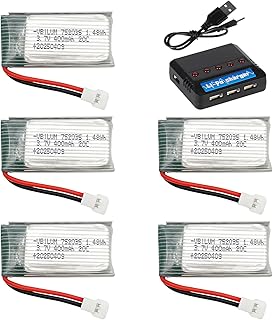
This small 3.7V pack is intended for micro RC planes, mini drones, and compatible craft that require a lightweight power source. Each battery weighs about 11.5g and measures 41×21×8 mm, with an XH2.54 style connector. The 400mAh rating makes it suitable for ultra-light models and for use in configurations where multiple cells are stacked for custom voltage needs in flight control projects.
Key considerations include compatibility with your model’s voltage requirements and plug types. These Tiny LiPos can be valuable for micro airframes or experimental builds where weight savings are critical.
HOOVO 3S 11.1V Lipo Battery 2200mAh 50C — EC3

The HOOVO 3S 11.1V 2200mAh battery is tailored for multi-motor RC vehicles including boats, cars, trucks, and aircraft. It uses an EC3 charging/discharging setup and emphasizes long cycle life with a stated 150+ cycles. The dimensions are approximately 104×34.5×24.5 mm, with an estimated weight around 174 g. The 50C discharge rating supports robust throttle response in aerobatic models and FPV gear that require brisk power delivery.
This pack suits hobbyists seeking a dependable, mid-weight option with a comfortable balance of runtime and power. Always verify that the connector type matches your aircraft’s power system and that your charging setup is compatible with EC3 connectors.
OVONIC 3S 3000mAh 50C Lipo Battery — Dean-Style T

The OVONIC 3000mAh 11.1V 50C pack delivers higher capacity for longer flight times on larger aircraft or multi-rotor platforms. It features a Dean-Style T discharge connector and a JST-XHR-4P charging plug, housed in a soft case for added protection. Dimensions are about 105×32×28 mm, with an approximate weight of 193 g. OVONIC’s pack is promoted for ISO quality, longevity (up to ~350 cycles), and improved efficiency, offering extended runtime and a degree of charging speed improvement.
Consider this option when flight time is a priority and your airframe can accommodate the slightly larger 3S 3000mAh format. Ensure the balance between weight, center of gravity, and power demands aligns with your model’s design.
OVONIC 3S 2200mAh 25C Lipo Battery — XT60

This OVONIC 2200mAh 11.1V 25C pack uses an XT60 connector, suited for RC airplanes, helicopters, and quads that require moderate discharge with reliable consistency. The pack dimensions are about 105×33×21 mm and weigh roughly 120 g. Although the 25C rating is lower than high-performance packs, it can be adequate for sport flying and models that do not demand the most aggressive power delivery. The pack’s LiPo chemistry and protective soft case emphasize safety and cycle life, with common references to long service life and efficient energy use.
Use this option when your aircraft requires a lighter, steady power source and your flying style prioritizes smooth throttle control over explosive bursts. Always confirm connector compatibility and charging requirements with your specific aircraft setup.
Buying Guide: Key Considerations for RC Airplane LiPo Batteries
- Voltage and cells: Most RC airplanes use 3S (11.1V) packs for balanced power and manageable weight. Ensure your airframe and ESC are rated for the battery’s voltage and discharge current.
- Capacity and weight: Higher mAh provides longer run time but adds weight. Match capacity to your aircraft’s weight budget and CG (center of gravity) requirements.
- Discharge rate (C): A higher C rating delivers more immediate current for takeoffs and quick maneuvers. For FPV or aerobatic planes, choose a higher C; for trainers or sport aircraft, a moderate C is often sufficient.
- Connector compatibility: Common connectors include XT60, EC3, and Dean-Style. Confirm both the battery and the model’s power system compatibility to avoid adapter use that can add resistance or risk failure.
- Size and form factor: Shorty packs or slim configurations help in tight fuselages and specific mounting locations. Check dimensions to avoid interference with landing gear, servos, or props.
- Weight distribution: Battery weight affects CG and pitch stability. Balance heavier packs with design considerations or adjust placement within the fuselage.
- Cycle life and safety: ISO-quality or LiPo-specific safety features help reduce risks associated with swelling and puncture. Use proper charging equipment and storage practices to extend battery life.
- Environmental considerations: Temperature affects LiPo performance. Avoid charging or discharging in extreme temperatures and store at partial charge for long-term storage.
When selecting among the five featured options, evaluate the airframe’s capacity to handle the weight, the required power for your typical flight profile, and the plug type compatibility with your ESC and charging gear. Keeping a spare battery with a suitable C-rating can help maintain consistent flight times and performance across flights.