Best Radio Transmitters for Drones: Top Controllers for Precise Flying
Finding the best radio transmitter for your drone is essential for reliable control and enhanced flight experience. This guide reviews five popular 2.4GHz controllers known for stable signals, multi-channel capabilities, and user-friendly features. Each transmitter supports various drone types including FPV racing quads, fixed-wing models, and multirotors.
| Product | Channels | Frequency | Key Features |
|---|---|---|---|
| FLYSKY FS-i6X 10CH | 10 | 2.4GHz | Bidirectional communication, 135-channel hopping, sensor data support |
| DTXMX FS-i6X 10CH | 10 | 2.4GHz | Unique ID pairing, voltage telemetry capability, multi-channel hopping |
| Alaohu FS-i6X 10CH | 10 | 2.4GHz | AFHDS2A stable signal, supports iBus and PWM outputs |
| Radiolink AT10II 12CH | 12 | 2.4GHz | DSSS&FHSS anti-interference, telemetry with battery & speed data, 2.5 mile range |
| BETAFPV LiteRadio 2 SE ELRS V3 | Flexible | 2.4GHz ELRS | Open-source configurator, FPV simulator support, USB-C charging |
FLYSKY FS-i6X 10CH 2.4GHz RC Transmitter Controller
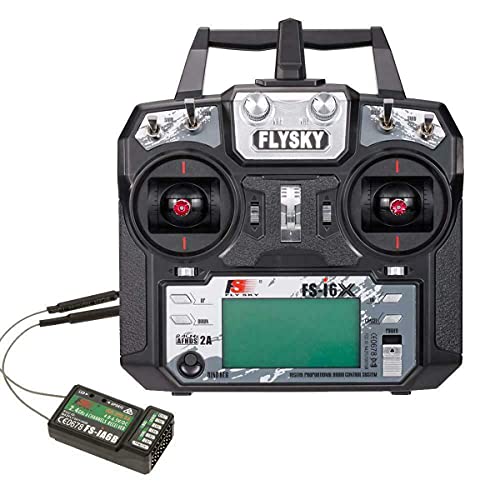
The FLYSKY FS-i6X transmitter operates on a 2.4GHz band, dividing 135 channels with frequency hopping over 16 channels to minimize interference. It supports up to 10 channels when paired with the FS-iA10B receiver, otherwise it defaults to 6 channels with the FS-iA6B receiver.
This controller supports bidirectional communication, allowing real-time data feedback from sensors such as temperature and altitude. It features servo calibration and i-BUS protocol support, providing versatile compatibility with various RC models including drones and boats.
DTXMX FS-i6X 10CH Radio Transmitter and Receiver

This DTXMX-designed FS-i6X model features a unique ID recognition system that pairs transmitter and receiver exclusively, preventing cross-interference with other systems. Operating on a frequency band of 2.408-2.475GHz with 135 channels, it hops between 16 channels to maintain a strong link.
Voltage telemetry is supported when used with an additional FS-CVT01 module, enabling battery voltage display on the transmitter screen. Ideal for airplane, helicopter, and FPV drone pilots, it offers reliable communication and extended control possibilities.
Alaohu FS-i6X RC Transmitter and Receiver FS-iA6B 10 Channels

The Alaohu FS-i6X utilizes the 2.4GHz AFHDS2A protocol known for stable signal quality and a long controlling distance. It supports multi-mode outputs including PWM 6CH, PPM 8CH, S.bus 10CH, and i.bus 10CH, making it highly flexible for different RC vehicle types.
The transmitter pairs with AFHDS2A series receivers, enabling use with multirotor drones, fixed-wing planes, and RC cars or boats. The transmitter’s menu allows users to activate channel 10 when using the FS-iA10B receiver for precise control over additional functions.
Radiolink AT10II 12 Channels RC Transmitter and Receiver

Radiolink’s AT10II is a premium 12-channel transmitter combining DSSS and FHSS technologies, providing excellent anti-interference capabilities and an extended 2.5-mile (4 km) air control range. Its 7dBi high gain antenna further stabilizes signal transmission.
This controller displays real-time telemetry including battery voltage, speed, altitude, and RSSI when paired with compatible telemetry modules and flight controllers like Pixhawk or Mini Pix. Additional features include throttle lock, fail-safe settings, dual/triple rates, and endpoint adjustments for highly customizable flying.
BETAFPV LiteRadio 2 SE ELRS V3 Radio Transmitter

The BETAFPV LiteRadio 2 SE stands out with its support for the ELRS (ExpressLRS) protocol and open-source BETAFPV Configurator V2 software, allowing advanced configuration and firmware updates. It supports FPV simulators for training and USB-C charging for convenience.
This versatile transmitter is compatible with popular FPV drone platforms, featuring joystick calibration, simulator connectivity, and enhanced firmware support for smooth, low-latency control. Its integration with Windows, macOS, and Linux makes it ideal for hobbyists and competitive FPV pilots.
Buying Guide For Drone Radio Transmitters
Choosing the right radio transmitter for your drone depends on several key factors:
- Channels and Control: More channels provide advanced control for complex drones with additional functions like camera gimbals or lights. For typical drones, 6 to 10 channels are sufficient.
- Frequency & Interference Resistance: Most modern transmitters use 2.4GHz with frequency hopping and DSSS/FHSS technologies to minimize interference and maintain reliable connection in crowded areas.
- Telemetry Capability: Telemetry features offer real-time data such as battery voltage or signal strength, helping pilots monitor flight status and react promptly.
- Compatibility: Ensure transmitter compatibility with your drone’s receiver protocol, whether AFHDS, AFHDS2A, ExpressLRS, or others. Compatibility expands options for upgrades and accessories.
- Range and Signal Stability: Consider the maximum control range appropriate for your flying style, especially for long-range FPV flights or professional uses. Antenna gain and transmission technologies enhance signal quality.
- User Interface and Setup: A menu-driven interface with easy channel configuration, model memory, and fail-safe settings reduces setup time and allows quick adjustments on the field.
- Additional Features: Support for simulators, USB charging, firmware updating, and modular design can add value and future-proof your controller.
By evaluating these points alongside your drone’s specific needs, you can select a radio transmitter that ensures accurate, interference-free control, maximizing flight performance and safety.