Best Racing Drone Transmitter Options for Precise Control and Low Latency
The world of racing drones demands fast, reliable communication between the transmitter and receiver. This guide highlights five top transmitters and their key features to help American pilots choose gear that minimizes latency, reduces interference, and offers robust telemetry. Each option supports FPV racing setups with diverse compatibility across AFHDS2A, ExpressLRS, and other popular protocols. Below you’ll find a quick buying table, followed by in-depth product sections and a practical buying guide.
| Product | Brand | Key Benefit |
|---|---|---|
| FLYSKY FS-i6X | FLYSKY | Multi-channel, i-Bus support, widely available receivers |
| DTXMX FS-i6X | DTXMX | Unique ID pairing, bidirectional data with voltage feedback |
| Radiomaster Pocket ELRS | STARDRONE | ExpressLRS for long range and low latency, plug-and-play EdgeTX |
| Radiolink AT10II | Radiolink | 12 channels, telemetry, strong anti-interference with DSSS/FHSS |
| Radiolink AT9S Pro | Radiolink | 10/12 channels, telemetry, robust long-range with modularity |
FLYSKY FS-i6X 10CH RC Transmitter
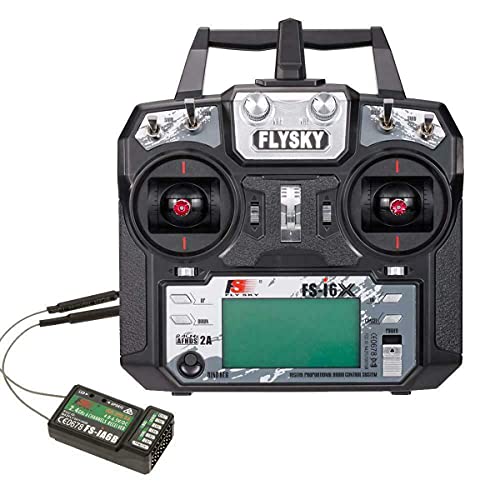
The FLYSKY FS-i6X is a widely adopted transmitter in FPV and RC circles, designed for versatility and upgrade potential. By default, it ships with a 6-channel FS-iA6B receiver, but it can be expanded to 10 channels when paired with a 10-channel FS-iA10B receiver. Key features include bidirectional communication, allowing data transmission from sensors and servo calibration to i-BUS support. Its multi-channel hopping frequency ranges from 2.408 GHz to 2.475 GHz across 135 channels, with the transmitter hopping among 16 channels to minimize interference. This makes it a practical option for budget-conscious racers who want reliable performance with room to grow.
What to consider: compatibility with your receiver and the desired channel count, potential need for an upgrade receiver, and how the bidirectional data could support flight data telemetry beyond basic control inputs. The FS-i6X is a solid entry point for beginners who plan to scale into more advanced telemetry setups as their flying skills improve.
DTXMX FS-i6X 6CH Transmitter With FS-iA6B

The DTXMX FS-i6X pairing emphasizes a balance between classic compatibility and modern anti-interference features. It offers multi-channel hopping in the 2.408–2.475 GHz band across 135 channels, reducing cross-talk with other transmitters in crowded airspaces. A standout feature is the Unique ID Recognition System, which binds the transmitter to its specific receiver to prevent interference from nearby systems. Additionally, bidirectional communication provides real-time data from the receiver, though a separate module may be required for voltage telemetry. This setup is well-suited for pilots who want dependable, interoperable control with clear pairing safeguards.
Practical takeaway: this option suits pilots who value strong binding security and straightforward compatibility with Flysky AFHDS2A receivers, while still offering telemetry with the right accessories. It’s especially relevant for those who race with mixed equipment or want a tried-and-true workflow.
Radiomaster Pocket ELRS Remote Controller
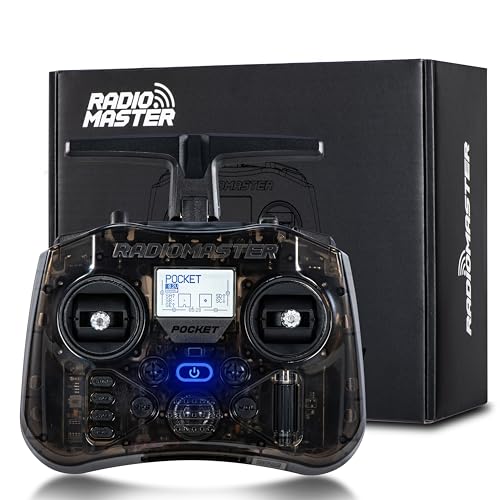
The Radiomaster Pocket ELRS stands out for its ExpressLRS-based connectivity, delivering long-range transmission with minimal latency. Preloaded with EdgeTX, it offers extensive customization possibilities, including Lua scripting and Crossfire compatibility. The handheld, portable design features 16-channel output, Hall-effect gimbals, and a responsive TRIM button to minimize drift. This transmitter is a strong pick for FPV racers who demand precise, low-latency control during fast maneuvers and who appreciate advanced firmware flexibility for tailor-made configurations. Battery packs (two 18650s) are required separately.
What to weigh: ELRS support is a major advantage for long-range racing and open-source firmware benefits, but it may require more setup time. It’s ideal for pilots who want cutting-edge control with easy access to firmware updates and customization options.
Radiolink AT10II 12 Channels Transmitter

The Radiolink AT10II provides 12 channels with a focus on telemetry, such as battery voltage and RSSI, and supports real-time data display on the radio screen when paired with compatible telemetry modules. Its anti-interference capability is aided by DSSS and FHSS communication along with a 7 dBi high-gain antenna, yielding a practical operational range up to several kilometers in optimal conditions. It also includes features like dual/triple rates, EPA, throttle lock, and programmable channel settings, making it a versatile option for FPV racers who want robust telemetry and precise throttle control.
Considerations include ensuring compatibility with your flight controller’s telemetry suite and verifying the availability of optional telemetry modules for full data display on the radio. It’s a strong all-around choice for pilots who want a feature-rich transmitter with hands-on control settings.
Radiolink AT9S Pro 10/12 Channels

The Radiolink AT9S Pro supports 10 to 12 channels and includes telemetry capabilities similar to the AT10II, with a focus on reliable long-range operation and stability. It offers DSSS/FHSS anti-interference, real-time voltage and flight data telemetry when paired with compatible modules, and multiple programmable mix configurations for complex aircraft setups. It is suitable for pilots who want a high-channel-count transmitter with robust telemetry integration and flexible control options for different aircraft types, including FPV racing drones, quads, and fixed-wing models.
Key considerations include the balance of channels versus weight, the availability of telemetry modules for full data streaming, and firmware support for EdgeTX or other open firmware ecosystems. This transmitter is well-suited for experienced racers seeking extensive customization and telemetry capabilities.
Buying Guide: Key Purchase Considerations And Comparisons
- Channel count and future-proofing: If you plan to grow from 6 to 10 or 12 channels, choose a transmitter that easily supports higher channel counts through compatible receivers or expansion modules.
- Telemetry capabilities: Decide whether you need real-time telemetry (battery voltage, RSSI, altitude, etc.). Some models require extra modules to enable full telemetry on the display.
- Interference avoidance: Consider systems with hopping frequencies (2.408–2.475 GHz) and multiple channels to reduce cross-talk with other pilots, particularly in crowded airspaces or competitions.
- Compatibility and ecosystem: Check whether the transmitter works with your flight controller, receiver, and software (EdgeTX, AFHDS2A, ExpressLRS). Open firmware may offer deeper customization for advanced pilots.
- Build quality and ergonomics: For competitive racing, a comfortable grip, precise gimbals (preferably hall-effect), and reliable switches matter for consistent control during long sessions.
- Battery and power considerations: Some transmitters require separate battery packs. Verify battery availability and weight, plus any trade-offs between weight and center-of-gravity balance for your aircraft.
- Support and future updates: Look for brands with active firmware development, clear documentation, and accessible customer support to address compatibility or feature questions over time.
- Budget vs features: Budget models offer solid control for beginners, but racing enthusiasts may prioritize telemetry, range, and firmware flexibility when allocating funds.
In summary, your best choice depends on whether you value price and upgrade paths (FLYSKY FS-i6X or DTXMX variants), or long-range and telemetry-forward systems (Radiolink AT series or Radiomaster Pocket ELRS). Evaluate how each transmitter pairs with your receivers and flight controller, what telemetry you need on the radio, and how much setup time you’re willing to invest for peak race performance.