Best Quadcopter Return-to-Home Drones for Safer Flights
When selecting a quadcopter, a reliable Return-To-Home (RTH) feature is a key safety consideration. The following drones offer robust RTH capabilities along with GPS, auto-return, and easy flight controls—ideal for beginners and seasoned flyers alike. This guide highlights five options that emphasize safe returns, stable hovering, and clear cameras for capturing moments from the skies.
| Product | Key Benefit | Camera | Special Feature |
|---|---|---|---|
| Holy Stone HS700E 4K UHD | Premium stabilization | 4K EIS with 130° FOV | 5GHz FPV, easy auto return |
| Holy Stone HS360S | Lightweight, hassle-free flights | 4K UHD camera | Smart return home, 10000 ft control |
| Karuisrc GPS FPV Drone | All-in-one FPV with built-in screen | 4K HD camera | Auto return when signal drops |
| PL-715 GPS Drones | Versatile flight modes | 4K HD camera | Follow Me, Waypoint, Circle Fly |
| Ruko U11MINI 4K | Ultra-portable | 4K video, 8K photo | 5.5″ touchscreen controller |
Note: All models below provide Return-To-Home or equivalent features plus GPS-assisted hover and stable image capture to help pilots recover a flight safely if signal or battery issues occur.
Holy Stone HS700E 4K UHD Drone

The HS700E combines a 4K EIS camera with Smooth FPV transmission and a 130° field of view. It uses GPS positioning to enable reliable Return-to-Home when the signal is lost or the battery is low. The drone includes dual satellite positioning to improve hover accuracy and provides beginner-friendly controls such as Altitude Hold and Headless Mode. Its 5GHz FPV stream supports a stable live view, making it suitable for first flights and outdoor use.
Holy Stone HS360S GPS Drone

The HS360S is a lightweight GPS-enabled drone under 250g, designed for simple flights without FAA or Remote ID concerns. It features a 4K UHD camera with a GalaxyCore sensor and a wide 85° field of view. The drone supports a stable hover and real-time streaming via a redesigned controller that connects to a phone without requiring extra Wi‑Fi connections, enabling quick sharing of footage and easy tracking of the flight path. It also offers smart return home when connectivity is compromised.
Karuisrc GPS FPV Drone With Screen
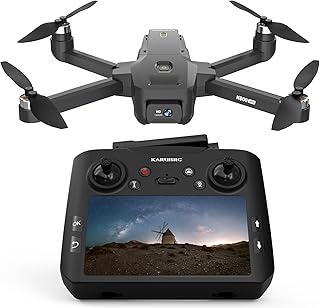
This drone integrates a built-in 4.5-inch LCD controller, letting pilots view live FPV without a separate smartphone. It features GPS-based Auto Return, ensuring the aircraft returns to its takeoff point if signal weakens or power runs low. The camera captures vivid, true-to-life imagery, making it effective for landscapes, action shots, and aerial photography while maintaining simple, beginner-friendly operation.
GPS Drones With Camera 4K (PL-715)

The PL-715 GPS drone offers a 4K camera with a 120° wide-angle lens and a 90° adjustable viewpoint. With 5GHz FPV transmission, it delivers smooth live video to a connected device, supporting features like Follow Me, Waypoint Flight, and Circle Fly. It provides up to 46 minutes of flight time with two batteries, enabling longer shoots, and a built-in altitude hold for steady monitoring in windy conditions.
Ruko U11MINI 4K (RC3)

The U11MINI 4K features a built-in 5.5″ touchscreen controller, allowing flight control without a connected phone. Weighing under 249g, it remains highly portable for travel. The drone captures 8K stills and 4K video with a 1/2-inch sensor, delivering high-resolution images for everyday adventures. The compact design and integrated display simplify setup and operation for new pilots.
Buying Guide: Quadcopter Return-To-Home Essentials
Return-to-Home reliability is a fundamental safety feature across consumer drones. When evaluating options, consider the following aspects to ensure a safe and enjoyable flying experience:
- RTH Precision: Look for GPS-assisted hover and RTH logic that triggers on low battery or lost signal. Check how accurately the drone returns to the takeoff point and how it handles interference or wind.
- GPS Availability: A strong GPS lock improves hover stability and RTH reliability. Some models include GLONASS or multiple satellite support for better positioning.
- Flight Time and Batteries: Longer flight times extend outdoor usability. Verify the availability of spare batteries and how quickly the drone can return to a safe landing after an extended flight.
- Camera Quality: For everyday captures, a 4K camera with a wide field of view yields clearer, more expansive footage. Consider stabilization (EIS or gimbal) to reduce shake during movement.
- Flight Modes: Beginner-friendly modes such as Altitude Hold and Headless Mode can reduce complexity, while Follow Me, Waypoints, and Circle Fly add creative options for experienced pilots.
- Portability: Weight and foldability affect travel convenience. Light, compact drones simplify airport or outdoor trips but may compromise on wind resistance.
- App and Controller Design: Some drones rely on dedicated controllers with built-in screens, while others use smartphone-based interfaces. Decide which control method suits your preference for immediacy and viewing comfort.
- Safety and Compliance: Check whether the drone falls under local airspace rules, and understand registration requirements in your area.
In selecting a model, align the drone’s RTH capability with your intended flying environment—indoor practice, park outings, or open outdoor spaces. The drones listed above provide a balance of reliable return features, stable hovering, and high-quality imaging to support a safe and enjoyable aerial photography or videography experience.