Best Planetary Model Solar System Kits for Kids and Home Learning
The following planetarium-themed kits offer hands-on science fun for kids while helping families explore astronomy at home or in the classroom. Each option provides a mix of interactive building, color-in craft, light projection, and informative facts to spark curiosity about the solar system. Below you’ll find five relevant kits, their key features, and a practical buying guide to compare what matters most for your needs.
| Product | Brand | Best For | Key Benefit |
|---|---|---|---|
| Glow-in-The-Dark Solar System Model Kit | Blue Marble Store | Young learners, hands-on assembly | Movable arms and glow effect |
| 64 PCS Solar System Project Kit | wookidel Store | School projects, classroom activities | Comprehensive set with many shapes and colors |
| Science Can Solar System for Kids | Science Can Store | Interactive projection and multilingual learning | Planetarium projector and bilingual features |
| Educational Insights GeoSafari Orbiting Solar System | Educational Insights Store | STEM lessons with visuals | NASA imagery and orbital display |
| Science Can Solar System Interactive Talking Model | Science Can Store | Engaging talking model and quizzes | 48 facts, 53 quiz questions, projector |
Glow-in-The-Dark Solar System Kit

This all-in-one kit lets kids build a 3D solar system with glow-in-the-dark accents. Includes six paint colors, glow paint, a brush, decals, and an educational poster. The sun and eight planets can be arranged with movable arms to reflect a dynamic model, enabling easy adjustments as curiosity evolves. The package also supports space-themed room decor with an engaging, kid-friendly setup.
64 PCS Solar System Project Kit

This set provides a complete toolkit for solar system projects, including foam discs, a sun model, varied foam balls, stars, flags, paints, brushes, and a guide. It’s designed to support classroom-style exploration or at-home projects, helping kids color, assemble, and learn about planetary arrangement. The durable materials encourage long-term use and repeated display.
Science Can Solar System for Kids
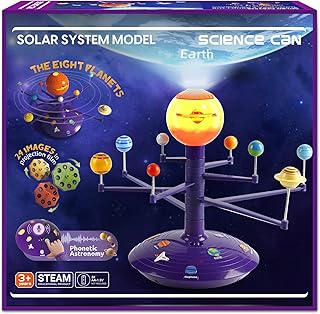
This talking solar system model projects the eight planets onto any surface, transforming ceilings into a planetarium. It features bilingual options (English and Spanish) and interactive facts via pattern-activated touch. With multiple disks included, the projector delivers a space-themed learning experience that combines visuals with language-driven education, appealing to diverse learners.
Educational Insights GeoSafari Orbiting Solar System

This kit combines a hands-on model with a projection feature featuring NASA imagery. Students can observe planetary orbits and examine an up-close view of space phenomena, making it a robust addition to STEM activities. The product emphasizes experiential learning and serves as classroom decor that reinforces astronomy concepts through vivid visuals.
Science Can Solar System Interactive Talking Model

This interactive model includes three knowledge cards with 48 space facts, English and French options, and 53 quiz questions to test understanding. The projector displays 24 full-color images via three disks, creating a mini planetarium experience. The combination of facts, interaction, and immersive visuals supports both independent and guided learning in astronomy.
Buying Guide
- Age suitability and learning goals: Choose a kit aligned with the child’s age, interest in science, and preferred learning style (hands-on building, storytelling, or projection-based exploration).
- Display and durability: Consider how the finished model will be used—on a shelf, in a bedroom, or as a classroom display—and whether materials are sturdy enough for repeated handling.
- Learning features: Look for kits offering a mix of tactile construction, visual projections, and informational content to support science literacy beyond memorization of facts.
- Projection and multimedia: If a planetarium projector or multi-disk system is important, ensure it uses easily accessible images and cleanly projects onto walls or ceilings.
- Language options: For multilingual or bilingual households, kits with English and other language options can enhance accessibility and comprehension.
- Storage and organization: A kit with clearly labeled components and simple assembly steps helps with ongoing use and reduces setup time for lessons or play sessions.
- Budget considerations: A broader kit with many parts can offer greater variety and reuse, but ensure it fits your budget and space constraints.
- Safety and materials: Check for non-toxic paints and child-safe components. Durable plastics and foam are preferable for longevity and ease of cleaning.