Best Planet Models for Kids: Engaging Solar System Toys for STEM Fun
The best planet models for kids blend hands-on learning with colorful, interactive play. This guide highlights five top picks that help children explore the solar system through painting, building, and imaginative pretend. Each option offers unique features—from glow-in-the-dark details to movable parts and tactile felt boards—so you can pick the right fit for your child’s age and interest. Read on for clear comparisons, images, and practical buying tips to support STEM curiosity at home or in the classroom.
| Product | Type | Key Benefit | Best For |
|---|---|---|---|
| National Geographic Glow-in-The-Dark Solar System Model Kit | 3D model kit | Glow effect and movable arms | Room decor + hands-on assembly |
| Science Can Solar System | Projector & talking model | Ceiling projection + bilingual facts | Ceiling planetarium experience |
| 4M Solar System Planetarium | Glow-in-the-dark model | Easy DIY with quick assembly | Beginner STEM project |
| BONNYCO Solar System Felt Board | Felt story board | Versatile felt pieces and labels | Montessori-style learning |
| Wooden Solar System Model Board (Xylolin) | Wooden puzzle + spheres | Durable, simple wooden design | Tactile, classroom-ready activity |
National Geographic Glow-in-The-Dark Solar System Kit

Build a glowing, moving solar system with a kid-friendly kit designed to captivate science-curious learners. The set includes six paint colors, glow accents, a brush, a palette, decals, and an educational poster. Students can customize all eight planets and the sun, then adjust the arms to position each world as desired. The glow-in-the-dark feature makes nighttime learning especially exciting, reinforcing spatial relationships and planetary order without the need for screens. This all-inclusive kit supports independent activity or guided classroom projects.
Key features: a complete solar system display that glows in the dark, kid-friendly assembly instructions, and movable arms for easy reconfiguration. It integrates art with astronomy, encouraging creativity while cementing scientific concepts like orbits and planetary sizes. This option is ideal for bedrooms, study corners, or science corners in classrooms seeking durable, visually striking displays that persist beyond a single lesson.
Science Can Solar System With Projector

This interactive model brings the solar system to life by projecting the eight planets onto any surface, turning a wall or ceiling into a planetarium. The device offers both English and Spanish options, making the learning experience accessible to bilingual households. When a planet is pressed on the base, the toy dispenses educational facts about astronomy, supporting independent exploration and language development. It includes 24 slides with full-color images of the solar system, spaceships, astronauts, and planets to spark curiosity and discussion.
Feature highlights include the talking mode for pronunciation practice, a simple switch between languages, and the projection mechanism that helps kids visualize orbital relationships. This model is especially suitable for kids who enjoy storytelling about space or who want a ceiling display to guide nightly bedtime learning. It blends auditory, visual, and tactile elements to support diverse learning styles.
4M Solar System Planetarium
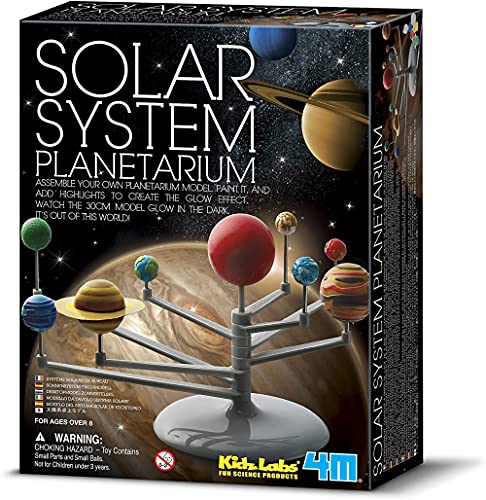
The 4M Solar System Planetarium is a classic DIY kit that emphasizes craft, science, and glow-in-the-dark learning. The package contains planets, stencils, a glow paint pen, rods, string, a wall chart with facts, and a set of quizzes to reinforce knowledge. Children assemble the solar system, paint each planet, and display their completed model. This option is well-suited for classrooms or family projects where step-by-step instructions and quizzes help structure the activity and assess comprehension as kids progress through the build.
With simple components and glow-in-the-dark elements, this kit provides a tactile, educational experience that reinforces memory through hands-on practice. It’s especially appropriate for younger children or beginners who benefit from guided assembly and a themed visual display that doubles as decor for a space-themed room or science fair project.
BONNYCO Solar System Felt Board

The BONNYCO felt board uses a tactile, Montessori-inspired approach to solar system learning. The set includes 13 planets, the Sun, Moon, and the full zodiac of symbolic elements, along with several dwarf planets. It also comes with adhesive hangers to mount the board for wall display and easy piece rearrangement. Labels actively support reading practice and independent exploration as kids assemble and reassemble the planetary lineup. This option is ideal for early learning environments, storytelling, and classroom centers that emphasize hands-on manipulation and language acquisition.
Wooden Solar System Model Board by Xylolin

This wooden model emphasizes tactile, durable play with eight planet-themed wooden balls and matching flashcards that explain each planet. The inclusion of three puzzle pieces allows children to assemble a simple solar system diagram, reinforcing spatial awareness and memory. The smooth, burr-free wooden design is designed for younger children who require safe, easy-to-grasp pieces. This option doubles as a decorative, educational toy for shelves and desks in a classroom or home learning space, making it a sturdy choice for repeated use and travel-friendly play.
Buying Guide: Key Purchase Considerations
- Age appropriateness: Look at the recommended age range to match cognitive development and fine motor skills. Some sets target earlyeducation, while others are better for elementary learners and beyond.
- Learning approach: Decide whether you want glow-in-the-dark art, projection-based learning, felt-board storytelling, or wooden puzzle activities. Each method reinforces memory through different senses.
- Durability and materials: Wooden and felt-board options tend to endure frequent handling in classrooms, while plastic kits may be lighter but can be less robust over time.
- Display and storage: Consider how the model will be displayed and stored. Glow kits become room decor; projector sets require a dark space; felt boards and wooden puzzles are portable and easy to store.
- Educational content: Check if the kit includes facts, labels, or posters to support science learning. Some sets include bilingual features or comprehensive fact sheets for deeper understanding.
- Hands-on vs. passive learning: Projects with build-it-yourself components encourage problem-solving and engineering thinking, while projector-based options emphasize visualization of celestial relationships.
- Maintenance and cleanup: Determine whether paints, decals, or fragile pieces require supervision and how easy cleaning is after use in a classroom or home setting.
- Budget and expansion: If you plan a full space-themed learning corner, pick a core kit and complement with additional planet figures or boards later to expand the display without excessive cost.
In sum, when choosing planet models for kids, prioritize a mix of engaging visuals, age-appropriate complexity, and durability. The options above cover a spectrum—from glow-in-the-dark kits and ceiling-projectors to felt boards and wooden puzzles—allowing educators and parents to tailor a space-themed learning environment that fits their space, time, and learning goals.