Best Hand Drones for Kids: Safe Indoor Flying Fun and Easy Learning
Hand-operated drones for kids blend simple, intuitive controls with high-tech thrills. These “throw-and-go” or motion-sensor toys let children explore flight, develop coordination, and enjoy interactive play without complex remotes. Below, five top options available on Amazon emphasize safety, durable design, and engaging LED features for indoor use. A quick summary table follows to compare core specs at a glance.
Product Comparison At A Glance
- Force1 Scoot Hand Operated Drone — indoor hover, motion sensors, durable webbed shell, LED lights.
- Force1 Scoot Skeet Drone — compatible with Scoot Skeet LED blaster, upgraded sensors, 360° flips.
- Mini Drone For Kids 8-15 — beginner friendly, throw-to-go, propeller guards, long flight with two batteries.
- Hoofun Flying Orb Ball — orbiting hand-controlled ball, safe ABS shell, indoor/outdoor play.
- Hand Operated Flying Toy Drone — 360° motion sensing, LED lights, indoor use, age-appropriate.
Force1 Scoot Hand Operated Drone for Kids or Adults

The Force1 Scoot is a first-in-class hand-operated drone designed for both kids and adults. It launches by hand, then uses smart motion sensors to guide its flight indoors. LED lights illuminate each flight, offering a visually engaging experience. The durable webbed shell protects propellers and nearby furniture, helping minimize accidents in small spaces. This model emphasizes simple, intuitive play—perfect for family fun, casual games, or learning basic flight concepts without a controller.
Key Features
- Original Scoot design with toss-to-launch operation.
- Indoor hover with obstacle-sensing motion guidance.
- Webbed shell protects hands, walls, and furniture during flights.
Force1 Scoot Skeet Mini Drone
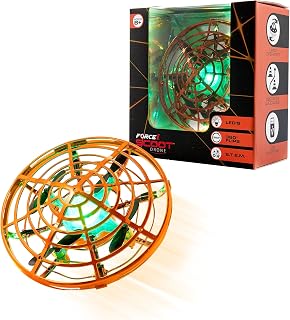
The Scoot Skeet series combines crowd-pleasing drone flight with an interactive game twist. This drone features motion-sensor LEDs and is compatible with the Scoot Skeet LED blaster ecosystem (sold separately). Like the original Scoot, it performs auto-hover and 360° flips, responding to hand movements with precision. It’s designed for indoor fun, enabling kids to practice timing and dexterity while chasing a dynamic aerial target during play sessions.
Key Features
- New motion LED sensors for enhanced detection and play value.
- Auto-hover, 360° flips, and obstacle sensing for responsive control.
- Compatible with Scoot Skeet blaster system for extended gameplay.
Mini Drone For Kids 8-15

This beginner-friendly mini drone emphasizes easy setup and forgiving flight. Features include One Key Takeoff or throw-to-go for quick starts, full propeller guards for safety, and Headless Mode so movement is relative to the pilot’s orientation. With five light modes, kids can enjoy night flights and easy visibility during friendly head-to-head races. The two included modular batteries extend playtime up to about 22 minutes per charge, balancing fun with portability.
Key Features
- One Key Takeoff and throw-to-go for rapid starts.
- Propeller guards and Headless Mode for safer and simpler control.
- Two modular batteries delivering extended flight time.
Hoofun Flying Orb Ball Toy 2023 Galaxy Ball

The Hoofun Flying Orb Ball blends a futuristic aesthetic with safe, self-guided flight. This hand-controlled orb uses a protective ABS shell and internal propellers to minimize risk during play. It is designed for versatile use—indoors and outdoors—making it a practical option for family activities, parties, or casual play. It responds to different throwing angles and speeds, producing varied flight paths and boomerang-like returns.
Key Features
- Safe, hand-controlled flying orb with no external transmitter.
- ABS protective shell and internal propellers for child safety.
- Versatile play suitable for indoor and outdoor environments.
Hand Operated Flying Toy Drone

This hand-operated drone emphasizes a hassle-free flight experience with a 360° motion-sensing system and bright LED lights. It is designed for young flyers with simple controls and compact size, making it ideal for indoor play in living rooms or bedrooms. The model prioritizes safe hitting-free interactions and quick learning curves for new pilots, supporting gradual skill development as children become more confident in manipulating 3D movement.
Key Features
- 360° motion sensors for responsive control.
- LED lights add visibility and excitement during flights.
- Compact, indoor-friendly design for versatile play spaces.
Buying Guide: How To Choose A Hand Drone For Kids
When selecting a hand-operated drone for a child, consider safety, durability, ease of use, and ongoing play value. The following factors help refine your choice:
- Age range and safety features: Look for propeller guards, cushioned housings, and certified materials. Select models designed for indoor use to minimize damage to walls and furniture.
- Flight controls and responsiveness: Hand gesture or motion-sensor control should suit the child’s coordination level. Simple toss-to-launch options are ideal for younger kids, while responsive sensors benefit older children practicing aerial awareness.
- Durability and build quality: A robust shell and protected propellers reduce breakage during inevitable bumps. A design that tolerates drops is valuable for first-time flyers.
- Battery life and charging: Longer flight times extend play sessions, while modular batteries or fast charging help minimize downtime between flights.
- Learning value and play pattern: Some models offer game-style play (e.g., target shooting or racing) to maintain engagement. Others focus on freestyle flight for imaginative play.
- Maintenance and replacements: Check availability of spare parts, such as extra propellers or batteries, to ensure longevity.
- Budget considerations: Entry-level hand drones provide basic features, while premium models may offer advanced sensors and longer flight times. Balance cost with intended use.
Additional Perspectives: Safety, Skill-Building, And Family Fun
Hand drones for kids are designed to be approachable and entertaining while promoting early STEM concepts. For families, these toys can become shared activities that teach timing, spatial awareness, and cause-and-effect thinking. Parents should supervise initial flights, establish safe play zones, and remind children to avoid delicate objects and pets during flights. As children gain confidence, gradually introduce more challenging flights or related science topics, such as aerodynamics and flight stability, to extend learning beyond pure play.